
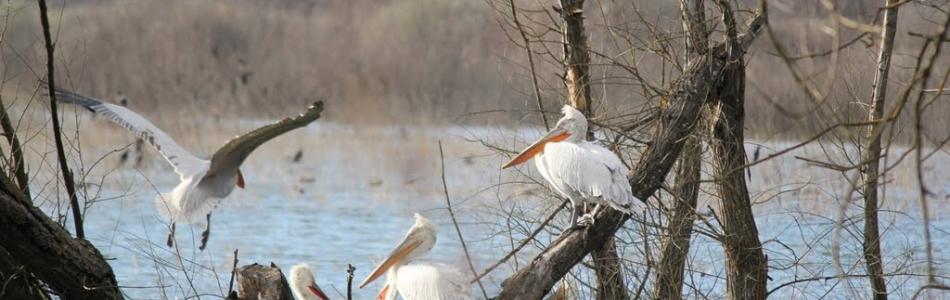
Lake Doirani is a cross-border, fish-pond lake and a great wetland on the border of Greece with FYROM.
It is located in the eastern part of the homonymous valley, formed at the southern foothills of Mount Kerkini and at an altitude of 150 m. It extends in the B-N direction, in the shape of an oval, maintaining the largest width in its northern part. Its total area is estimated at 43.1 square kilometers. Given the boundary bounded by a straight bearing from the south of the lake at the top of Beles, this clearly divides the lake into the west and east.
Doirani was reported to have formed during the Propagate Geological Period and initially its extent was 130 BC. and the depth of 10 meters. To the west is the Doirani town, to the east the village of Mouries and to the north to Mount Beles.
The flora of the lake includes myrtlefishes, riverbirds, wildcorns and saffrons. On its banks we find dense vegetation of rushes and dunes. It is surrounded by riparian forests, consisting of white willows and plane trees. Characteristic are climbing plants grown on trees. In the northeast of the lake, in the Municipality of Mourias, is the forest of the Mourias (or Thousands Trees), a remnant of an ancient alluvial forest, which today occupies 590 acres and is an important station for migratory birds. The forest is characterized as a Monument of Nature and consists of oak, alder, hedgehog and extraordinary plane trees. Doirani has developed a very important wetland that has been included in Special Protection Areas, as it provides a temporary shelter for 36 rare species of birds, including langona and the peach. The fish that live in the waters of Doiranis are the gourd, the gulan, the platitsa, the perch, the pike, the redhead, the gull and the wheat. Several aquatic insects, such as the dragonfly, and the Dreissenia polymorpha, live in the wetlands of Doirani.